
1. Root Causes of Inefficiency
Shale shaker inefficiency often stems from basic operational or maintenance oversights, not equipment limitations:
- Improper Screen Selection: Overly fine mesh causes blinding; excessively coarse mesh allows solids carryover
- Insufficient or Uneven Tension: Slack screens lead to localized wear and fluid bypass
- Mismatched Vibration Parameters: Too low G-force (<5G) reduces conveyance; too high (>8G) accelerates screen tearing
- Uneven Fluid Distribution: Misaligned possum belly causes one-side pooling, <50% screen utilization
- Neglected Maintenance: Broken springs, unlubricated bearings, or accumulated solids jamming the frame
Field Data Insight: A land drilling team found 70% of screen failures were due to improper tension or concentrated fluid impact.

2. Immediate Actionable Improvements
1. Screen Management: Choose Right, Install Tight, Last Longer
- Selection Guidelines:
- Perform a simple sieve analysis on returned cuttings. Example:
- Remove >150μm particles → Use 100-mesh screen
- Remove >74μm particles → Use 200-mesh screen (with pre-screening)
- Perform a simple sieve analysis on returned cuttings. Example:
- Installation Standards:
- Use a tension gauge to ensure 180–220 N/m (screen should produce a clear rebound when tapped)
- For dual-layer screens: Coarse upper layer handles 70% load; fine lower layer for precision separation
- Replacement Timing: Replace immediately if ≥3 tears or visible solids pass-through occur. Never “make do”
2. Field Vibration Parameter Adjustment
- G-force Control:
- Water-based mud: 5.5–6.5G (cuttings discharge as loose granules)
- Oil-based/high-viscosity mud: 6.5–7.5G (prevent blinding; reduce G-force if cuttings form clumps)
- Method: Adjust motor eccentric weights using a portable vibration meter
- Deck Angle Adjustment:
- Mud density <1.2 g/cm³: 0°–2° (flat or slight decline)
- Density ≥1.3 g/cm³: 3°–5° upward inclination (enhance conveyance)
- Fluid Pool Management: Ideal pool covers 1/3 of the screen front. If fully covered → reduce flow or increase G-force; if no pool → decrease G-force or increase flow
3. Daily Maintenance Checklist (Per Shift)
| Task | Inspection Method | Standard |
|---|---|---|
| Screen | Visual + manual check | No tears, no slack, no mud buildup |
| Springs | Visual | No fractures, no tilt, consistent height |
| Bearings | Hand touch (after shutdown) | ≤65°C (warm, not hot) |
| Frame Buildup | Scraper tool | No hardened mud chunks on screen box |
| Bolts | Wrench check | No loosening (critical: motor base, screen box joints) |
4. Operator Critical Actions
- Before Pumping: Confirm screen is clear of tools and properly tensioned
- During Operation: Observe discharge every 30 minutes (should appear as “bread crumbs,” not mud cakes or wet clumps)
- After Pumping: Flush residual cuttings with water to prevent screen damage
- Record Keeping: Simple log of screen change times, cutting characteristics, and anomalies (e.g., “14:20 Changed 200-mesh screen, sticky cuttings, adjusted G-force to 7.0”)
3. Equipment Selection Practical Advice
When purchasing new units, focus on:
- Vibration Motors: Sealed bearings (e.g., SKF/FAG), IP55 protection rating
- Screen Frame: Hot-dip galvanized or 304 stainless steel (mandatory for offshore/high-corrosion zones)
- Quick-Change Mechanism: Confirm installation ≤90 seconds (avoid complex tool dependencies)
- Deck Adjustments: Mechanical angle adjustment (not welded fixed), allows field fine-tuning
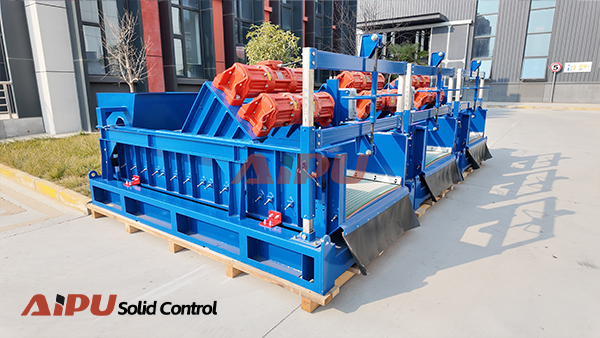
Note: Some units (e.g., AIPU Hunter series) offer mechanical dual-motion switching via lever adjustment of eccentric weights. Suitable for crews frequently handling sticky mud and high-flow scenarios. Operation relies on personnel experience, no electronic controls.
4. Real-World Case: Basic Improvements Deliver Results
Background: A Sichuan shale gas well using water-based mud had average screen life of 5 hours and cuttings moisture at 22%.
Diagnosis:
Diagnosis:
- Uniform 200-mesh screens while cuttings >150μm (confirmed by sieve test)
- Possum belly outlet misaligned leftward, right-side screen dry zone
- Operators guessed G-force settings without measurement
Improvements:
- Switched to 140-mesh (upper) + 200-mesh (lower) combo
- Realigned possum belly for centered flow across screen width
- Issued low-cost vibration stickersto mark 6.0G position
- Trained operators: Reduce G-force if cuttings clump; increase if pooling
Results (10-day tracking):
- Screen life: 5 → 16 hours
- Cuttings moisture: 22% → 14%
- Daily screen consumption: 4.2 → 1.3 sheets
- No new equipment costs—only process discipline and adjustments
5. Conclusion: Efficiency Lies in Details
Shale shaker efficiency gains require no “black magic”—just:
🔹 Respect Physics: Match G-force, angle, and mesh to mud and cutting properties
🔹 Master Basics: Tension, cleaning, observation, documentation
🔹 Crew Experience: Train operators to judge by cuttings appearance, motor sounds, and bearing temperature
🔹 Respect Physics: Match G-force, angle, and mesh to mud and cutting properties
🔹 Master Basics: Tension, cleaning, observation, documentation
🔹 Crew Experience: Train operators to judge by cuttings appearance, motor sounds, and bearing temperature
Equipment is a tool; people make the difference. Consistent screen checks and documented adjustments naturally improve efficiency. When selecting equipment, prioritize manufacturers with proven build quality and responsive support (e.g., AIPU’s focus on corrosion-resistant frames and bearing reliability), not marketing hype.
If you are interested in our solid control equipment and systems, you can contact us through info@aipusolidcontrol.com Contact Us
