
The shale shaker removes solids from drilling mud through a combination of mechanical vibration, gravity, and precisely sized screen openings. Aipu Solids Control has refined this process through over 15 years of engineering experience, producing shakers that achieve efficient solids separation across diverse drilling conditions.


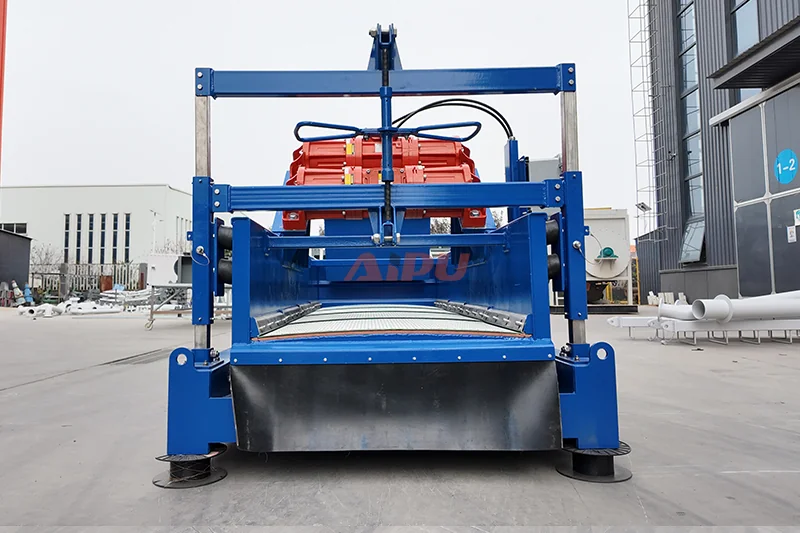
The separation process begins when drilling mud containing cuttings flows from the wellbore onto the shaker’s screen deck. A distribution box or weir spreads the fluid evenly across the screen surface, preventing concentrated flow that would overload one area while leaving others underutilized. As the mud contacts the vibrating screen, several physical processes occur simultaneously that drive the separation.
The Role of Vibration in Separation
Vibration is the primary mechanism that drives solids removal. Aipu vibrating motors, sourced from premium manufacturers including Ital-Vibras, Martin, and Oli, spin eccentric weights at precisely controlled speeds to generate the required acceleration force, typically 6.0G to 7.5G for Aipu Hunter series shakers. This vibration creates a throwing motion that lifts cuttings off the screen surface and propels them forward toward discharge. Meanwhile, the liquid fraction of the mud drains through screen openings under gravity and the vibration-induced pressure differential. The combination of forward conveyance and downward drainage creates the continuous separation that makes shale shakers effective.
Screen Technology and Cut Points
The screen is where separation actually occurs. Aipu provides API-certified screens ranging from API 40 to API 200 mesh. A 40-mesh screen has approximately 40 openings per linear inch and allows larger particles to pass, suitable for surface hole drilling where cuttings are large and high throughput is needed. A 200-mesh screen has much finer openings and removes very small particles, appropriate for production zones where protecting the formation is critical. The API RP 13C standard defines cut points that help operators predict what particle sizes will be removed at each mesh specification. Aipu screens are available in both stainless steel frames for maximum durability and composite frames for lighter weight with corrosion resistance.
The Dewatering Effect
As cuttings travel toward the discharge end, the vibration continues to drain residual mud from the cuttings pile. This dewatering effect is important because it maximizes fluid recovery while producing drier cuttings that are easier to handle and dispose of. Aipu shakers with adjustable deck angles from minus 1 degree to plus 5 degrees allow operators to control the residence time of cuttings on the screen, affecting both separation quality and dewatering effectiveness.
Partner with Aipu for certified quality. Contact us at info@aipusolidcontrol.com to discuss your requirements and discover the Aipu difference in API Q1 certified solids control equipment.
If you are interested in our solid control equipment and systems, you can contact us through info@aipusolidcontrol.com Contact Us
