
Understanding how a linear motion shale shaker works helps operators optimize its performance and diagnose operational issues. Aipu Solids Control designs its linear motion shakers with clear engineering principles that deliver reliable solids separation across diverse drilling conditions.


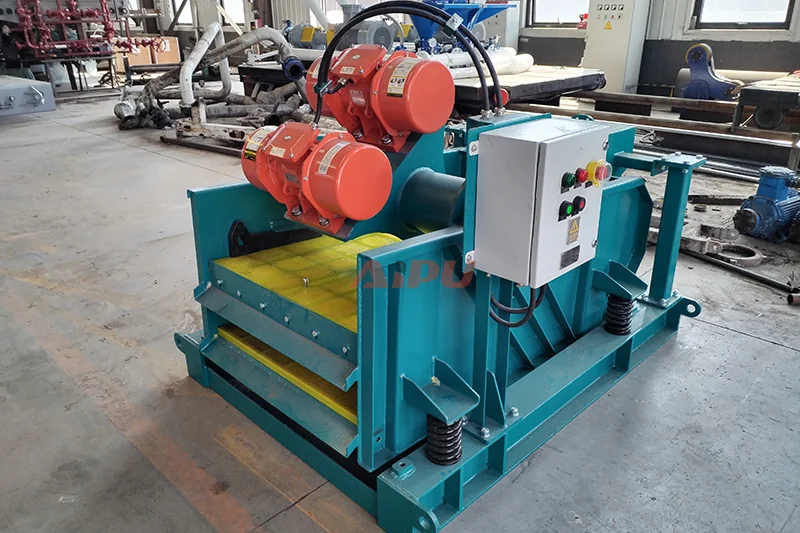
The operating principle begins with drilling fluid containing drilled cuttings entering the shaker at the feed end, typically through a distribution box or header that spreads the flow evenly across the screen width. As the fluid flows onto the vibrating screen panels, the linear motion—generated by two counter-rotating motors—produces a straight-line vibration that performs two simultaneous functions: conveying solids toward the discharge end and driving fluid through the screen openings. Aipu Hunter series shakers achieve this using premium Ital-Vibras, Martin, or Oli motors precisely matched in pairs and mounted at a specific angle relative to the screen deck to produce the optimal vibration direction.
The separation process depends on the relationship between vibration characteristics and screen mesh size. At 6.0G to 7.5G of acceleration, Aipu shakers produce rapid screen movement that prevents cuttings from settling or accumulating on individual screen openings—a process called stratification—while allowing fluid and fine particles smaller than the mesh openings to pass through. Particles larger than the screen openings are conveyed forward by the linear motion and ultimately discharged as dry cuttings. The adjustable deck angle, from minus 1 degree to plus 5 degrees on most Aipu models, controls the residence time of material on the screens. Steeper angles increase conveyance speed for high-volume applications, while flatter angles provide more time for fluid drainage.
Several factors influence shaker performance in practice. Flow rate must not exceed the shaker’s rated capacity, which varies by model from the compact Hunter-Mini to the high-capacity Hunter-MG4T tandem. Mud properties—particularly viscosity and gel strength—affect how easily fluid drains through screens; high-viscosity muds may require coarser screens or reduced flow rates. Formation characteristics determine the size and nature of drilled cuttings, which influences screen selection. Aipu provides comprehensive application guidance to help operators optimize these factors for their specific drilling programs.
Manufactured in Aipu’s 50,000 square meter Xi’an facility under API Q1 certified quality management, every linear motion shaker undergoes factory acceptance testing to verify vibration characteristics and separation performance. With over 15 years of experience, Aipu shakers have demonstrated reliable operation in more than 30 countries worldwide.
Partner with Aipu for certified quality. Contact us at info@aipusolidcontrol.com to discuss your requirements and discover the Aipu difference in API Q1 certified solids control equipment.
If you are interested in our solid control equipment and systems, you can contact us through info@aipusolidcontrol.com Contact Us
