
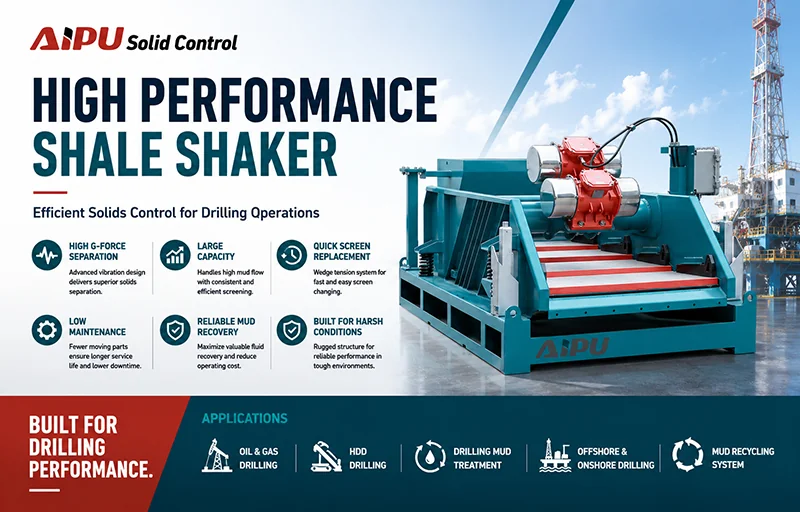
Controlling the feed rate to your shale shaker equipment is critical for maintaining effective solids separation and preventing operational problems. Aipu Solids Control engineers its shaker equipment to handle a wide range of flow conditions while providing operators with the tools needed to manage feed distribution effectively.


Feed Rate and Separation Performance
The relationship between feed rate and separation performance is fundamental to shaker operation. As feed rate increases, the fluid pool on the screen extends further toward the discharge end. The goal is to maintain the pool endpoint within the active screening area, leaving adequate dry screening length at the discharge end for final fluid drainage from cuttings. When feed rate exceeds capacity, the pool extends past the screen end and fluid carrying fine solids cascades into the clean tank — a condition known as flooding. Conversely, excessively low feed rates may result in poor solids conveyance and uneven screen loading. Aipu specifies the maximum feed rate for each shaker model based on the screen area, G-force, and typical drilling fluid properties.
Feed Distribution Methods
Proper feed distribution across the full screen width is as important as total feed rate. Aipu shakers incorporate engineered flow distributors designed to spread the incoming fluid evenly across the screen deck. For multiple-shaker installations, a distribution box or manifold equally divides flow between units. The weir design is critical — a properly designed weir creates a uniform sheet of fluid across the width of the screen rather than concentrated streams that overload localized areas. Operators should periodically verify that flow distribution remains even, as debris accumulation, wear on distributor plates, or changes in mounting level can create uneven patterns.
Operational Adjustments
Feed rate control involves several operational adjustments. The primary control is the deck angle: increasing the angle (steeper) increases the effective pool depth, which increases throughput capacity, while decreasing the angle extends retention time for better separation. On variable-speed shakers, vibration intensity can be adjusted to match feed conditions. When feed rate varies — such as during connections or trips — operators should adjust deck angle accordingly or consider using the bypass until stable circulation resumes. Aipu’s control systems can automate these adjustments based on real-time monitoring of pool depth and vibration parameters, reducing operator workload while maintaining consistent separation performance.
Choose Aipu for API Q1 certified quality. Contact us at info@aipusolidcontrol.com to discuss your shale shaker equipment requirements and discover why drilling professionals worldwide rely on Aipu solids control solutions.
If you are interested in our solid control equipment and systems, you can contact us through info@aipusolidcontrol.com Contact Us
