
In the complex and demanding environment of drilling operations, the management of drilling fluid, or “mud,” is a critical determinant of efficiency, safety, and cost. The drilling fluid serves multiple essential functions: cooling and lubricating the drill bit, carrying cuttings to the surface, maintaining hydrostatic pressure to control formation fluids, and stabilizing the wellbore. As the fluid circulates, it becomes contaminated with drilled solids of varying sizes. The efficient removal of these solids is paramount, and this is where the mud cleaner plays a specialized and indispensable role within the solids control equipment hierarchy.
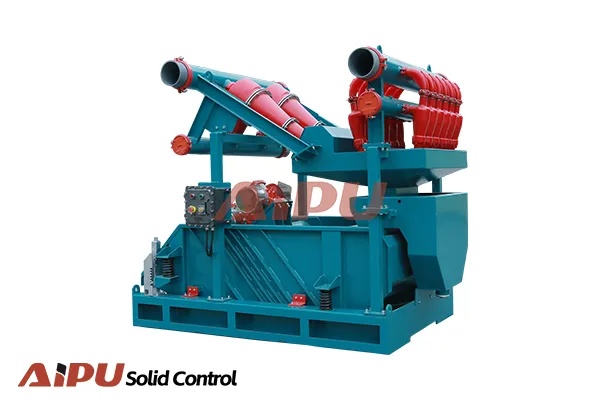

A mud cleaner is a hybrid piece of equipment that combines a hydrocyclone (or a bank of hydrocyclones) with a fine-mesh vibrating screen, typically a shale shaker. Its primary function is to remove fine, abrasive solids—generally in the size range of 15 to 74 microns (silt)—from weighted drilling fluids. This specific application addresses a significant challenge in solids control: the limitations of individual equipment when dealing with barite-weighted muds.
The Operational Principle and Design
The operational sequence of a mud cleaner is a two-stage process. First, the fluid underflow from the main rig shale shakers, which still contains valuable weighting material (barite) and undesirable fine drilled solids, is fed into the inlet of the hydrocyclones. Hydrocyclones operate on centrifugal force. The feed slurry enters tangentially, creating a rapid vortex. Heavier and coarser particles are forced to the walls and descend through the conical section to discharge as underflow (the “apex” discharge). The lighter overflow, comprising cleaner fluid and the very finest particles, exits through the top “vortex finder.”
In a standard desander or desilter, this underflow, a slurry of solids and liquid, would be discarded. However, in a weighted mud system, this underflow contains a high concentration of expensive barite. Therefore, in a mud cleaner, the hydrocyclone underflow is directed onto a fine-mesh screen (often 150 to 200 mesh, or 74 to 105 microns) on a vibrating shaker. This screen allows the liquid and barite, which is ground to a particle size mostly below 74 microns, to pass through and return to the active mud system. The larger, undesirable drilled solids, which are typically less dense and larger than barite particles, are retained on the screen and discarded as waste.
This design elegantly solves the economic dilemma of barite recovery. Using a fine-mesh shaker alone on a full mud stream would quickly blind (clog) with solids and lose vast quantities of barite. Using only hydrocyclones on a weighted mud would discard barite along with the drilled solids. The mud cleaner effectively separates the two processes, using the hydrocyclone to create a concentrated slurry of solids and then using the screen to perform a size-based separation that salvages the barite.
Specific Applications and Operational Considerations
The deployment of mud cleaners is not continuous but strategic, tied directly to the properties of the drilling fluid and the nature of the formation being drilled.
1. Weighted Mud Systems: This is the primary and most critical application. When the mud density exceeds approximately 10.5 ppg (1.26 SG), the economic value of the barite necessitates its recovery. Mud cleaners are typically brought online once the mud is weighted and are used to process the underflow from the primary shale shakers and possibly the underflow from upstream hydrocyclones (desanders). They are crucial for maintaining low solids content in high-density muds, which directly impacts rheological properties like plastic viscosity and gel strengths.
2. Control of Low-Gravity Solids (LGS): The continuous build-up of low-gravity solids (drilled cuttings, often with a specific gravity of 2.6-2.8) is detrimental. They increase mud weight without contributing to hydrostatic control, raise viscosity, increase wear on pumps and drill strings, and can contribute to thick filter cakes and differential sticking. By targeting the fine silt range, mud cleaners effectively curb the accumulation of these abrasive LGS, helping to keep their volume percentage below the recommended threshold of 6%.
3. Alternative to Centrifuges: In some operational scenarios, especially where the ultra-fine solids (below 15 microns) are not yet a severe problem, a mud cleaner can serve as a cost-effective alternative to a decanting centrifuge for intermediate solids removal. While centrifuges are superior for colloidal size removal and can perform a more precise density-based separation (e.g., “barite recovery” mode), mud cleaners offer a robust, mechanically simpler, and less expensive solution for fine solids control.
4. Unweighted Mud Systems: In water-based or low-density non-aqueous fluid (NAF) systems, mud
About AIPU Solid Control
For professionals seeking reliable solid control solutions, AIPU Solid Control offers advanced equipment designed for efficiency and durability. Our products are engineered to meet the demanding requirements of modern operations, providing:
- High-efficiency separation technology
- Robust construction for extended service life
- Energy-efficient operation
- Comprehensive technical support
- Customizable solutions for specific operational needs
With a focus on innovation and quality, AIPU Solid Control continues to develop solutions that enhance operational efficiency while maintaining environmental compliance.
If you are interested in our solid control equipment and systems, you can contact us through info@aipusolidcontrol.com Contact Us
