
In the complex and high-stakes operation of drilling an oil or gas well, the drilling fluid, or “mud,” serves as the lifeblood of the process. Its primary functions—hydrostatic pressure control, wellbore stability, cuttings transport, and bit cooling/lubrication—are critical to safety and efficiency. However, the continuous circulation of this fluid presents a significant challenge: the efficient and economic removal of drilled solids. While a series of surface equipment, notably the shale shaker, desander, and desilter, form the primary solids control hierarchy, the mud cleaner occupies a unique and vital niche within this system, bridging the gap between mechanical separation and the preservation of valuable liquid and colloidal components.
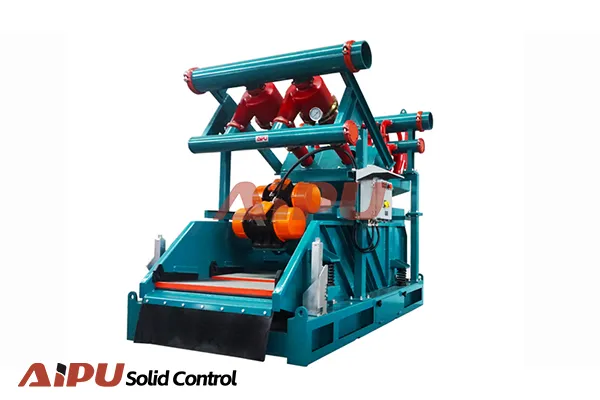

Fundamental Definition and Operating Principle
A mud cleaner is essentially a combination unit integrating a fine-mesh screen (typically 150 to 325 mesh) with a bank of hydrocyclones (usually 4-inch or 5-inch cones). Its operational sequence is deliberate. First, the weighted drilling fluid, laden with solids from the wellbore, is fed into the hydrocyclones. These cones use centrifugal force to separate particles based on size and density. The heavier, coarser solids are ejected from the cone apex (the underflow) as a damp slurry. Crucially, the overflow from the cyclones—which contains the finer solids, the liquid phase, and the all-important weighting material (e.g., barite)—is discharged onto the integrated fine-screen shaker.
This second stage is the cleaner’s defining feature. The screen captures the fine, low-gravity solids (often referred to as “drilled solids” or “clay-size particles”) that passed through the cyclones, while allowing the cleaned fluid and the barite to pass through and return to the active mud system. The key objective is selectivity: to discard the detrimental, abrasive drilled solids while conserving the expensive, high-density weighting agent and the liquid base.
The Critical Problem: Barite Recovery and Fine Solids Management
To appreciate the mud cleaner’s role, one must understand the nature of solids in a weighted mud system. Drilled solids, primarily composed of clays, shales, and silts, are typically low-specific-gravity (around 2.6 g/cm³). They are detrimental for multiple reasons: they increase plastic viscosity and gel strengths, reduce drilling rate, contribute to filter cake thickness, promote differential sticking, and cause abrasive wear on pumps and tubulars. In contrast, barite (specific gravity ~4.2 g/cm³) is intentionally added to provide necessary density. It is a major cost component of the fluid.
Traditional desanders (10-inch cones) and desilters (4-inch or 5-inch cones) are excellent for removing larger and medium-sized drilled solids in unweighted muds. However, in a weighted mud, these hydrocyclones are non-selective; they will discard both drilled solids and barite with equal efficiency if the particle size distributions overlap. Discharging valuable barite is economically unsustainable. Conversely, relying solely on shale shakers with very fine screens to remove fine solids is often impractical due to screen blinding and limited fluid capacity.
The mud cleaner elegantly solves this dilemma. The primary hydrocyclone stage removes a significant portion of solids, including some barite, in the underflow. However, the integrated fine screen then rescues most of the barite (which, due to its higher density and often larger particle size, tends to remain in the overflow stream and pass through the screen) from this underflow slurry, returning it to the system. The screen primarily rejects the ultra-fine, low-gravity solids that are most harmful to fluid rheology.
Primary Applications and Operational Considerations
The mud cleaner is not a constant-use machine but a strategic tool deployed under specific conditions:
1. Weighted Mud Systems: Its foremost application is in muds weighted with barite or other weighting agents. It is the primary tool for controlling fine solids content in such fluids without excessive barite loss.
2. High-Solids Environments: During periods of high penetration rates, when the solids loading exceeds the capacity of primary shakers, or when encountering clay-rich formations, mud cleaners provide an essential secondary cleaning stage.
3. Alternative to Centrifuges: While decanting centrifuges offer superior fine solids separation, they represent a higher capital and operational cost. Mud cleaners offer a robust, mechanically simpler, and often sufficient solution for many drilling scenarios, particularly onshore or in less critical hole sections.
4. Sump Cleanup and Mud Recovery: Mud cleaners are highly effective for processing sweep fluids, cleaning out suction pits, or recovering valuable mud from discarded solids piles, minimizing waste and environmental footprint.
Successful operation requires careful attention to several factors:
Feed Pressure and Flow Rate: Hydrocycl
About AIPU Solid Control
For professionals seeking reliable solid control solutions, AIPU Solid Control offers advanced equipment designed for efficiency and durability. Our products are engineered to meet the demanding requirements of modern operations, providing:
- High-efficiency separation technology
- Robust construction for extended service life
- Energy-efficient operation
- Comprehensive technical support
- Customizable solutions for specific operational needs
With a focus on innovation and quality, AIPU Solid Control continues to develop solutions that enhance operational efficiency while maintaining environmental compliance.
If you are interested in our solid control equipment and systems, you can contact us through info@aipusolidcontrol.com Contact Us
