
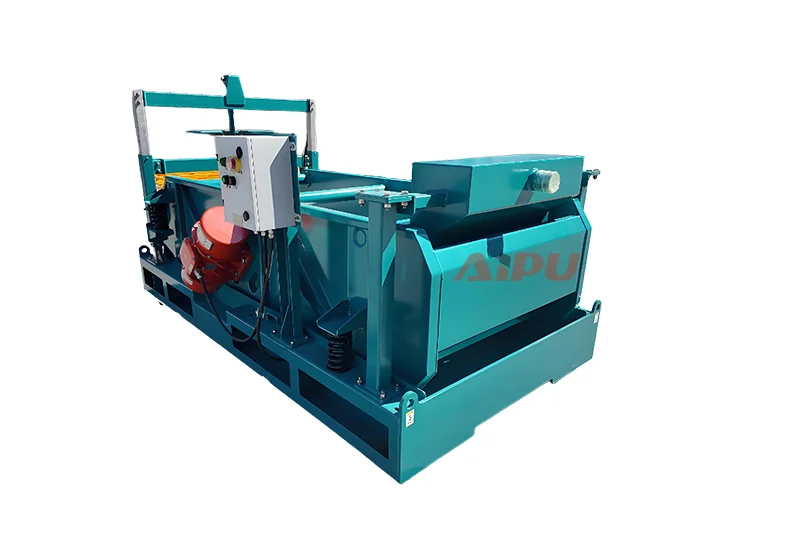
Digital twin technology creates a virtual replica of a physical shale shaker that mirrors its real-time operating state, enabling simulation, analysis, and optimization without interfering with live drilling operations. The digital twin receives continuous data from the physical shaker sensors and uses physics-based models to represent the equipment behavior, providing a platform for testing operational changes, diagnosing problems, and training personnel. Aipu Solids Control is developing digital twin capabilities for its Hunter series shaker range, building on over 15 years of solids control engineering data and API Q1 certified manufacturing precision at the 50,000 square meter Xi’an facility.


Digital Twin Architecture and Modeling Approach
The Aipu digital twin for shale shakers consists of a physics-based model representing the shaker mechanical structure, motor dynamics, and fluid-solid separation process. The structural model uses finite element data from the shaker design to accurately represent the mass, stiffness, and damping characteristics of the basket, frame, and suspension system. The motor model captures the electrical and mechanical dynamics including torque-speed characteristics, thermal behavior, and vibration generation. The separation process model simulates the flow of drilling fluid across the screen surface and the conveyance of solids based on the shaker motion parameters, screen mesh characteristics, and fluid properties. The Hunter-MG4D double-deck configuration with 5.4 square meters of total screen area and 280 cubic meters per hour capacity requires a more complex digital twin that separately models the upper and lower deck flow and separation dynamics, with the interaction between decks represented through the fluid transfer from upper to lower screening surfaces. The digital twin is continuously updated with real-time sensor data from the physical shaker, maintaining synchronization between the virtual and physical states. This synchronized model allows operating scenarios to be simulated with confidence that the results will accurately represent physical equipment behavior.
Applications and Operational Value of Digital Twins
The digital twin provides value across multiple operational use cases. For troubleshooting, engineers can replay the sequence of events leading to an alarm or abnormal condition in the virtual environment, examining parameters at higher resolution than typically available through standard monitoring. For process optimization, different combinations of screen mesh sizes, deck angles, and motor speeds can be simulated to identify the configuration that maximizes separation efficiency for specific drilling conditions without requiring physical screen changes for each trial. For the Hunter-MG5 with 3.8 square meters screen area and 180 cubic meters per hour capacity, the digital twin can simulate operation at flow rates approaching and exceeding the rated capacity to determine the practical operating envelope and identify the conditions that would require upgrading to a higher-capacity model. For training, new operators can practice responding to abnormal situations in the virtual environment, developing skills without risk to equipment or drilling operations. The digital twin also supports design improvement by providing Aipu engineers with operational data that informs the next generation of Hunter series shaker designs. Aipu has exported shakers to more than 30 countries, and the digital twin platform will provide these customers with a powerful tool for maximizing the value of their solids control investment through simulation-based optimization and training.
Choose Aipu for API Q1 certified quality. Contact us at info@aipusolidcontrol.com to discuss your solids control requirements and discover why drillers worldwide trust Aipu equipment.
If you are interested in our solid control equipment and systems, you can contact us through info@aipusolidcontrol.com Contact Us
