
Understanding the roles and relative advantages of solids control shale shaker equipment compared to hydrocyclone systems is essential for designing effective solids control strategies. Aipu Solids Control manufactures both shale shakers and hydrocyclone-based equipment and provides objective guidance on their appropriate application in drilling operations.
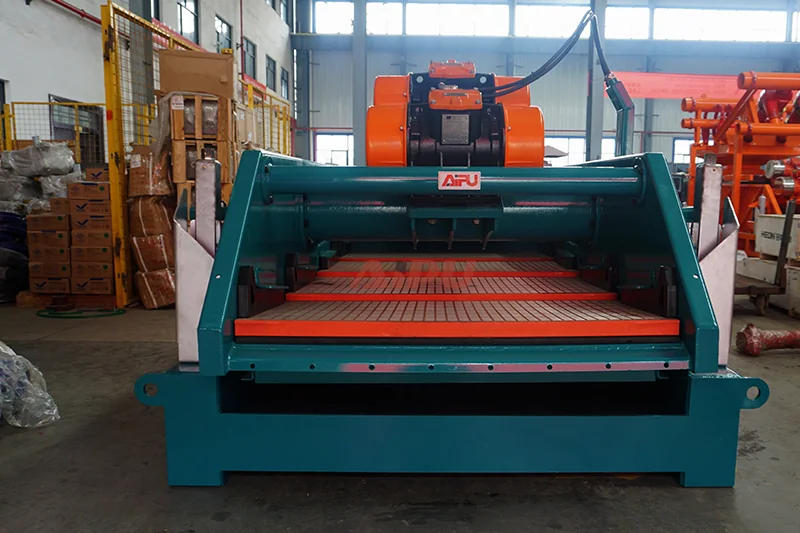


Shale shakers and hydrocyclones operate on fundamentally different principles. Shale shakers use mechanical vibration and screen mesh for particle size-based separation, while hydrocyclones use centrifugal force generated by high-velocity fluid rotation to separate particles by density and size. This fundamental difference determines their appropriate roles in the solids control system. Shale shakers remove the largest particle fraction—typically above 74 to 100 microns depending on screen selection—and handle variable solids loading without significant performance degradation. Aipu Hunter series shakers, operating at 6.0G to 7.5G with premium Ital-Vibras, Martin, and Oli motors, excel at this primary separation role with screen mesh available from API 40 to API 200.
Hydrocyclones—including desanders, desilters, and mud cleaners—process the finer particle fraction that has already passed through the shaker screens. Desanders typically remove particles down to 45-74 microns, while desilters target particles in the 15-40 micron range. Hydrocyclones require relatively constant feed pressure and flow rate for optimal performance, and their efficiency degrades with variable solids loading. This is why shale shakers must precede hydrocyclones in the solids control chain—removing the coarse, variable solids fraction before the fluid reaches the hydrocyclones, which perform best with consistent feed conditions. Aipu’s API Q1 certified manufacturing at our 50,000 square meter Xi’an facility ensures that both shaker and hydrocyclone equipment meet documented quality standards.
Several comparative factors influence the choice between shakers and hydrocyclones for specific applications. Initial cost typically favors hydrocyclones for a given flow capacity, but operating costs—particularly energy consumption for feed pumps and wear on cyclone liners—can shift the comparison over time. Maintenance requirements differ: shakers require screen changes as the primary maintenance activity, while hydrocyclones require liner replacement and pump maintenance. Space requirements may favor one technology over the other depending on rig layout. In practice, drilling operations use both technologies sequentially rather than selecting one over the other.
The optimal approach is an integrated system where Aipu shale shakers perform primary coarse separation, followed by hydrocyclone-based desanders and desilters for progressively finer separation, with centrifuges handling the finest particle fraction. This sequential approach leverages the strengths of each technology while the shaker’s primary separation protects downstream equipment from overload. Aipu provides complete solids control systems including shakers, desanders, desilters, and centrifuges, enabling customers to implement this integrated approach with equipment from a single source. With over 15 years of experience and equipment in more than 30 countries, Aipu understands how to configure these complementary technologies for optimal overall solids control performance.
Partner with Aipu for certified quality. Contact us at info@aipusolidcontrol.com to discuss your requirements and discover the Aipu difference in API Q1 certified solids control equipment.
If you are interested in our solid control equipment and systems, you can contact us through info@aipusolidcontrol.com Contact Us
