
The dual deck shale shaker design represents an evolution in solids control technology that addresses the fundamental limitation of single-deck shakers: the trade-off between processing rate and separation fineness. Understanding the design and working principle helps operators select the optimal configuration for their drilling program. Aipu Solids Control’s Hunter-MG4D dual deck shaker demonstrates these engineering principles through its carefully optimized 5.4 square meters screening system.

Mechanical Design Architecture
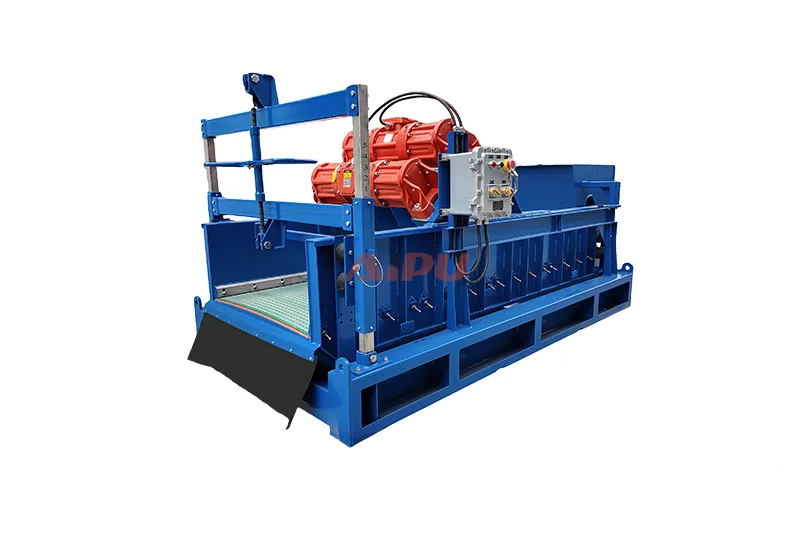
The Aipu Hunter-MG4D features a rigid main frame supporting two vertically stacked screen decks within a single shaker basket assembly. The basket is mounted on a spring suspension system that isolates the vibration from the supporting structure while allowing controlled elliptical motion. Two premium vibrating motors from Ital-Vibras, Martin, or Oli are mounted at specific angles on the basket to produce the desired motion profile. The motors are synchronized mechanically through the basket structure, creating a uniform vibration pattern across both screen decks. A feed box at the inlet end distributes drilling fluid evenly across the full width of the upper deck, ensuring that the entire screen area is utilized. The basket geometry provides adequate fluid pooling depth at the feed end for rapid initial processing, transitioning to a thinner fluid layer toward the discharge end for final drying of cuttings.
Flow Path and Separation Dynamics
Drilling fluid enters the feed box and flows onto the upper screen deck. The vibration motion conveys solids toward the discharge end while the fluid passes through the upper screen mesh. The fluid that passes through the upper deck, now with reduced solids content, lands in a collection pan that directs it to the feed end of the lower deck. The lower deck performs secondary separation on this pre-cleaned fluid, removing finer particles before the cleaned fluid exits to the mud tank. Cuttings from both decks discharge separately, with the upper deck producing coarser, drier cuttings and the lower deck producing finer, wetter solids. The dual discharge streams can be combined for disposal or separated if the coarser upper-deck cuttings have potential reuse value. The Hunter-MG4D processes up to 280 cubic meters per hour with this dual deck flow path, achieving separation results that single-deck shakers require multiple units to match.
Choose Aipu for API Q1 certified quality. Contact us at info@aipusolidcontrol.com to discuss your solids control requirements and discover why drillers worldwide trust Aipu equipment.
If you are interested in our solid control equipment and systems, you can contact us through info@aipusolidcontrol.com Contact Us
