
Understanding how shale shaker equipment removes drilled cuttings from drilling fluid is fundamental to optimizing solids control performance. Aipu Solids Control designs its Hunter series shakers based on thorough engineering principles that ensure reliable cuttings removal across diverse drilling conditions.


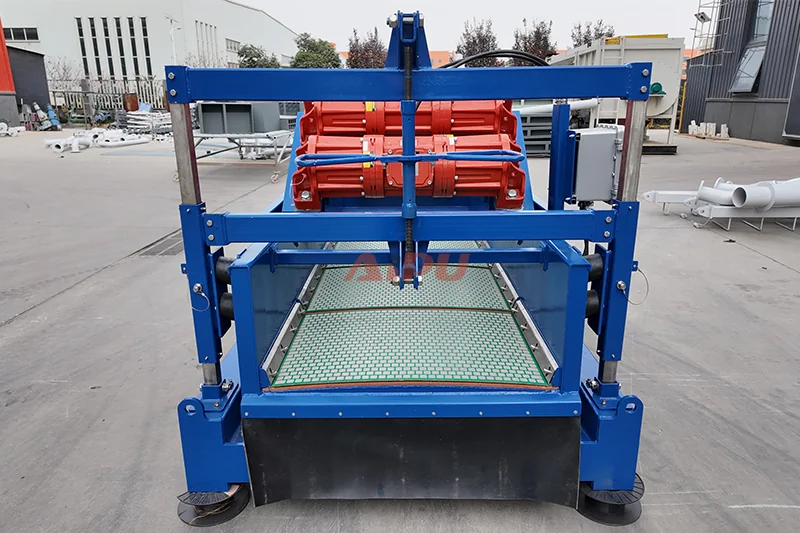
The cuttings removal process begins when drilling fluid carrying rock fragments returns from the wellbore and enters the shaker through the feed distribution system. Aipu designs feed boxes or headers that spread the incoming flow evenly across the full width of the screen deck, ensuring that all available screening area is utilized. As the fluid and cuttings mixture spreads across the vibrating screen panels, the separation process begins immediately. The vibration—generated by counter-rotating premium Ital-Vibras, Martin, and Oli motors—produces a linear motion at 6.0G to 7.5G of acceleration that performs two simultaneous functions: conveying solids toward the discharge end of the deck and driving drilling fluid through the screen openings.
The physical mechanism of separation involves stratification of the cuttings bed on the screen surface. Smaller particles tend to migrate downward through the cuttings bed toward the screen openings, while larger particles remain on top and are conveyed forward by the vibration. This stratification is essential for effective separation and depends on proper vibration characteristics. Aipu’s linear motion design promotes the well-organized stratification that maximizes both screening efficiency and cuttings conveyance. The adjustable deck angle from minus 1 degree to plus 5 degrees controls how quickly cuttings travel across the screens—faster conveyance at steeper angles for high-volume applications, slower conveyance at flatter angles for maximum dewatering of the discharged cuttings.
As cuttings travel across the screen deck, they progressively lose fluid content through drainage. The vibration provides the energy needed to overcome the surface tension and viscosity of the drilling fluid, allowing it to drain through the screen openings. This dewatering effect is one of the most valuable functions of the shaker, recovering expensive drilling fluid while producing drier cuttings that are easier and cheaper to handle, transport, and dispose. The efficiency of this dewatering depends on factors including vibration intensity, cuttings residence time on the screens, fluid properties, and cuttings characteristics. Aipu’s engineering team has optimized Hunter series designs to maximize this dewatering through the interaction of all these factors.
The final stage of cuttings removal is discharge from the end of the screen deck. Properly dried cuttings fall from the shaker into a collection area for subsequent handling, while the recovered drilling fluid passes through the screens into the collection sump beneath and returns to the active mud system. Aipu’s API Q1 certified manufacturing at our 50,000 square meter Xi’an facility ensures that every shaker component contributing to this cuttings removal process meets documented quality standards. With over 15 years of experience and equipment operating in more than 30 countries, Aipu has refined the cuttings removal performance of Hunter series shakers to meet the demanding requirements of modern drilling operations worldwide.
Partner with Aipu for certified quality. Contact us at info@aipusolidcontrol.com to discuss your requirements and discover the Aipu difference in API Q1 certified solids control equipment.
If you are interested in our solid control equipment and systems, you can contact us through info@aipusolidcontrol.com Contact Us
