
Understanding the operating principles behind a drilling mud shale shaker gives drilling personnel the knowledge needed to optimize its performance and quickly diagnose operational issues. Aipu Solids Control designs its shakers with clear, well-understood engineering principles that translate directly into reliable separation performance in the field.
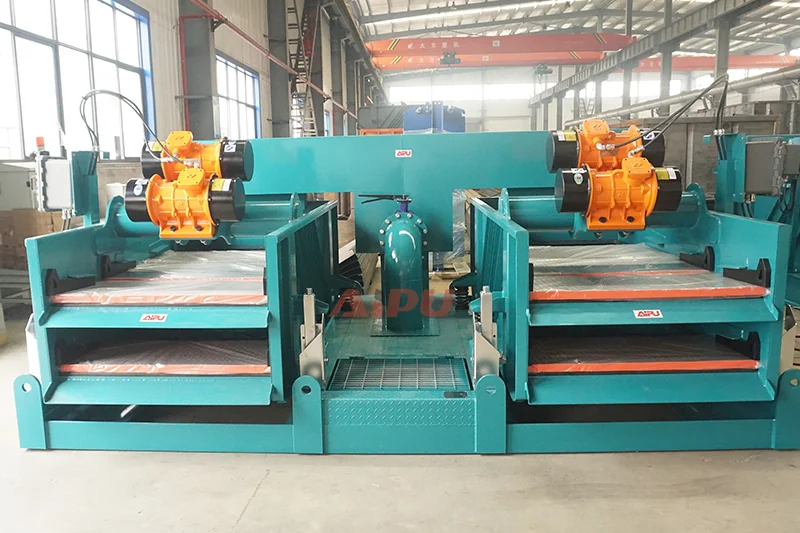

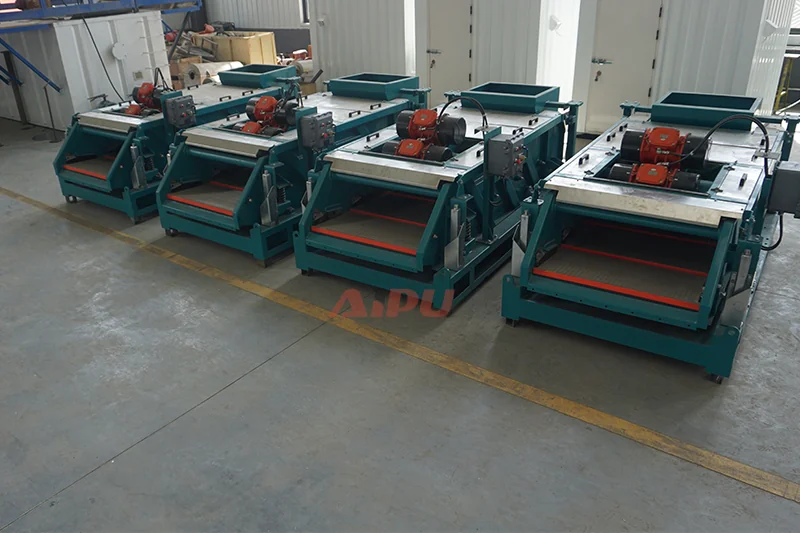
The process begins when drilling fluid carrying drilled cuttings exits the wellbore through the flow line and enters the shaker at the feed end. A distribution system—typically a feed box or weir arrangement—spreads the flow evenly across the full width of the screen deck. Even distribution is critical because concentrated flow on one section of the screen overwhelms that area while leaving other sections underutilized, reducing effective screening area and promoting premature screen wear. Aipu feed systems incorporate design features specifically intended to achieve uniform flow distribution across the entire screen width, ensuring that available screening area is fully utilized for maximum throughput capacity.
Once the fluid spreads across the screen surface, the separation mechanism takes over. Two counter-rotating vibrating motors mounted on the shaker basket generate straight-line vibration at a carefully engineered angle—typically 45 to 60 degrees relative to the screen surface. As the motors rotate at the same speed in opposite directions, the horizontal force components cancel while the vertical force components combine, producing linear motion. This linear motion conveys solids forward toward the discharge end while simultaneously lifting and dropping particles, creating the momentary separation between cutting and screen that allows fluid to drain through the mesh openings. Aipu Hunter series shakers operate at 6.0G to 7.5G of acceleration, with premium Ital-Vibras, Martin, and Oli motors delivering the consistent, balanced vibration that this separation mechanism requires.
Several operational factors affect how effectively the shaker works in practice. Deck angle, adjustable from minus 1 degree to plus 5 degrees on Aipu shakers, controls the balance between retention time and conveyance speed—steeper for faster throughput, shallower for better dewatering. Screen mesh selection determines the particle size cutoff, with API 40 through API 200 available from Aipu to match specific drilling requirements. Vibration amplitude, adjusted through the eccentric weight settings on Aipu motors, affects both separation intensity and screen life. Flow rate must not exceed rated capacity, which ranges from 50 cubic meters per hour for the compact Hunter-Mini to 420 cubic meters per hour for the tandem Hunter-MG4T configuration. Manufactured in Aipu’s 50,000 square meter Xi’an facility, every shaker undergoes factory acceptance testing to verify that all these factors work together as designed.
Partner with Aipu for certified quality. Contact us at info@aipusolidcontrol.com to discuss your requirements and discover the Aipu difference in API Q1 certified solids control equipment.
If you are interested in our solid control equipment and systems, you can contact us through info@aipusolidcontrol.com Contact Us
