
Understanding how a drilling mud shale shaker removes solids from drilling fluid provides operators with the knowledge to optimize separation performance and diagnose issues when separation quality degrades. Aipu Solids Control designs its Hunter series shakers based on well-established principles of vibration-assisted solid-liquid separation, refined through over 15 years of manufacturing experience and field performance data from equipment operating worldwide.


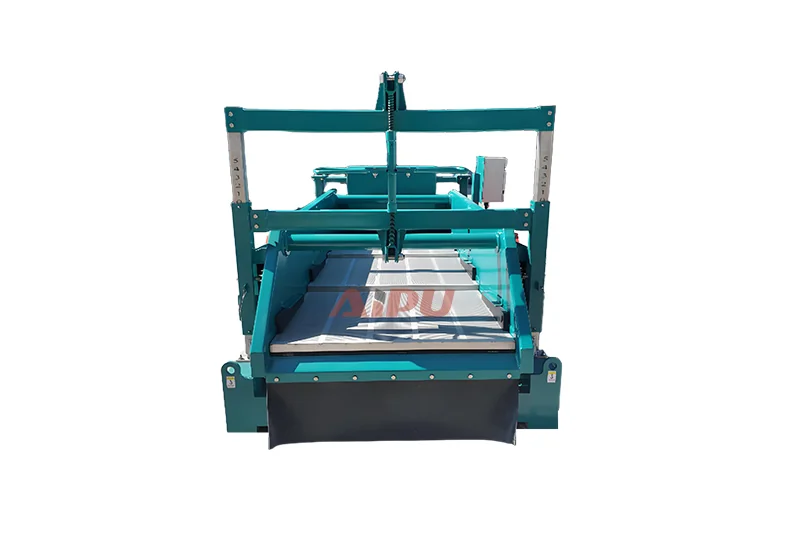
The solids removal process begins when drilling fluid containing drilled cuttings enters the shaker at the feed end through a distribution box or weir system. Aipu feed systems are designed to spread the flow evenly across the full width of the screen deck, ensuring that all available screening area is utilized. Uneven flow distribution concentrates solids loading on one area of the screen, creating a bottleneck that reduces effective capacity and can cause localized screen blinding. The even distribution achieved by Aipu feed designs maximizes the use of the screen area and promotes uniform screen wear across the deck width.
Once on the vibrating screen surface, two simultaneous processes occur. First, the linear vibration generated by Aipu counter-rotating Ital-Vibras, Martin, or Oli motors at 6.0G to 7.5G acceleration conveys solids forward toward the discharge end in a controlled throwing motion. Each vibration cycle lifts cuttings from the screen surface and propels them forward, preventing accumulation and maintaining a consistent solids layer across the deck. Second, the vibration drives drilling fluid and particles smaller than the screen openings through the screen mesh to the collection sump below. The throwing action creates momentary separation between solids and screen surface, allowing trapped fluid to drain effectively. Particles larger than the screen openings remain on top of the deck and are progressively conveyed to discharge as dried cuttings.
Several factors influence separation effectiveness in practice. Screen mesh size determines the maximum particle size that passes through—Aipu offers API 40 through API 200 mesh in both stainless steel and composite frame options. Deck angle, adjustable from minus 1 degree to plus 5 degrees on most Aipu models, controls the residence time of material on the screens and thus the thoroughness of separation. Flow rate must remain within the rated capacity of the specific Aipu model, from 50 cubic meters per hour for the Hunter-Mini to 420 cubic meters per hour for tandem configurations. Mud properties, particularly viscosity and gel strength, affect how readily fluid drains through screen openings. Aipu engineering support helps operators optimize these variables for their specific drilling conditions, and equipment manufactured in our 50,000 square meter Xi’an facility under API Q1 certification ensures that the designed separation performance is achieved consistently in the field.
Partner with Aipu for certified quality. Contact us at info@aipusolidcontrol.com to discuss your requirements and discover the Aipu difference in API Q1 certified solids control equipment.
If you are interested in our solid control equipment and systems, you can contact us through info@aipusolidcontrol.com Contact Us
