
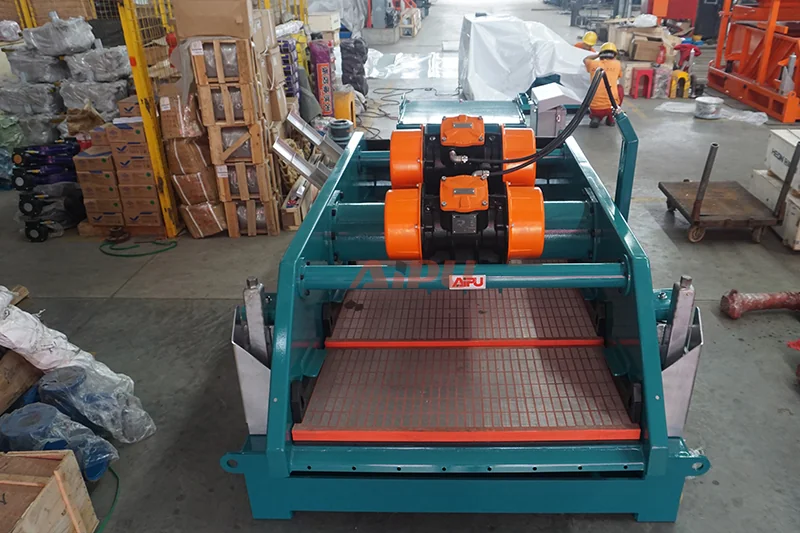
Selecting the right shale shaker for your drilling rig is a decision that impacts every aspect of your solids control program. With Aipu offering eight distinct models spanning capacities from 50 to 420 cubic meters per hour, making the right choice requires careful evaluation of several key factors.


Assess Your Flow Rate Requirements
The most fundamental selection criterion is processing capacity. Your shale shaker must handle the maximum mud circulation rate with adequate reserve margin. Aipu recommends sizing your shaker at 1.25 to 1.5 times your peak flow rate. For a small rig circulating 80 cubic meters per hour, the Aipu Hunter-MG3 with its 120 cubic meter per hour capacity provides comfortable headroom. Medium rigs operating at 150 cubic meters per hour will find the Hunter-MG5 at 180 cubic meters per hour well-matched, while high-volume operations pushing 300-plus cubic meters per hour may benefit from the Hunter-MG4D double-deck shaker or a dual tandem configuration.
Match Vibration Motion to Your Mud and Formation
Aipu offers three distinct vibration motion types, each optimized for different drilling scenarios. Linear motion shakers excel with water-based mud in sandstone and hard rock formations, where their straight-line force rapidly conveys large, heavy cuttings. Balanced elliptical motion provides superior handling of sticky, high-viscosity cuttings typical of shale and clay formations, especially when using oil-based mud. For operations drilling through multiple formation types, Aipu Hunter-MGD dual-motion shakers enable real-time switching between linear and elliptical modes, delivering unmatched adaptability without changing equipment.
Screen Selection: Mesh Size and Frame Material
The screen panels are where the actual separation happens, and choosing the right specifications is critical. Mesh size dictates separation precision: 40 to 60 mesh for coarse removal with maximum throughput, 80 to 120 mesh for balanced performance in most onshore wells, and 150 to 200 mesh for ultra-fine separation in demanding horizontal or shale gas wells. Frame material matters too. Stainless steel frames offer maximum durability for abrasive formations, while composite frames provide lighter weight and corrosion resistance for offshore and chemical-intensive environments. Aipu provides API-certified screens in both frame types with a quick-replace design that cuts screen change time by half.
Consider Your Operating Environment
Location matters. Onshore desert operations demand heavy-duty steel construction and dust-resistant electrical systems. Offshore platforms require corrosion-resistant coatings, stainless steel fasteners, and compact footprints. Arctic operations need cold-temperature rated materials and lubricants. Aipu customizes every shaker to its destination environment, offering material upgrades, specialized coatings, explosion-proof certifications, and electrical systems configured to regional standards. This flexibility ensures your shaker performs reliably regardless of deployment location.
Evaluate Total Cost of Ownership
The purchase price of a shale shaker tells only part of the story. Screen panel consumption, motor maintenance, energy efficiency, and downtime costs all contribute to the true cost of ownership. Aipu shakers are designed for long service life with minimal wear parts, quick-change screen systems that reduce non-productive time, and energy-efficient motors from leading brands including Ital-Vibras, Martin, and Oli. The result is a shaker that costs less to operate over its lifetime than cheaper alternatives.
Ready to upgrade your solids control system? Contact Aipu today at info@aipusolidcontrol.com for expert consultation, customized equipment recommendations, and a competitive quotation. Our team is standing by to help you achieve cleaner mud, lower costs, and better drilling performance.
If you are interested in our solid control equipment and systems, you can contact us through info@aipusolidcontrol.com Contact Us
