
Correct installation of a drilling mud shale shaker is fundamental to achieving the designed separation performance and equipment service life. Aipu Solids Control provides comprehensive installation guidance with every Hunter series shaker, and this article summarizes the key installation requirements that drilling contractors and rig-up crews should follow to ensure proper shaker setup from day one. Equipment manufactured in Aipu 50,000 square meter Xi’an facility under API Q1 certification deserves installation that matches its manufacturing quality.
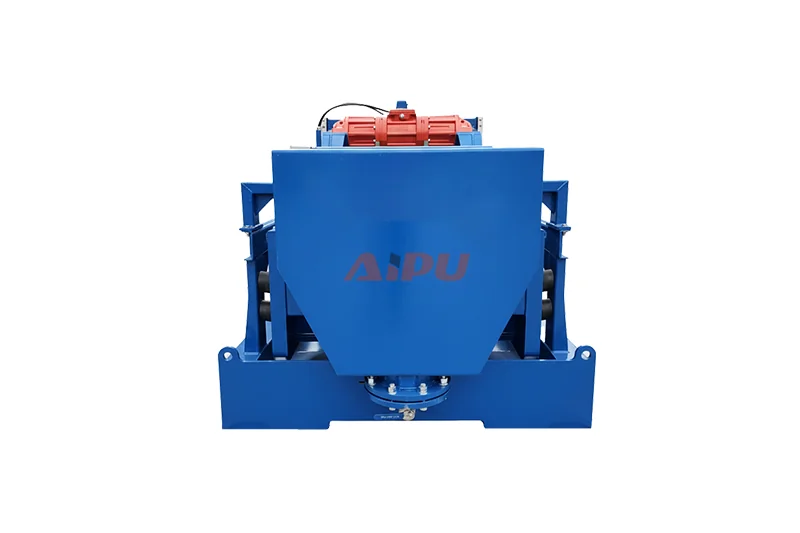

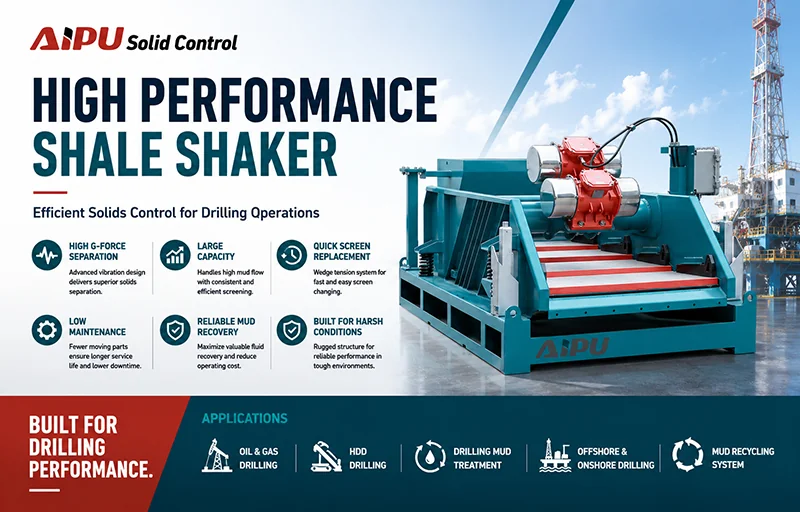
Foundation and support structure preparation is the starting point for correct installation. The shaker support structure must be rigid enough to resist vibration transmission without flexing or resonating. Any flexibility in the support structure reduces the effective vibration energy transmitted to the screens and can create damaging vibration feedback. Aipu provides support frame specifications including loading data, mounting bolt patterns, and rigidity requirements. The support surface must be level within the tolerances specified in Aipu installation documentation—an out-of-level installation causes uneven material distribution across the screen deck and accelerates uneven screen wear. Steel support structures must be properly anchored to prevent movement, and wood cribbing or other temporary supports are strongly discouraged.
Shaker placement and interface connections must be carefully executed. The shaker should be positioned to receive flow directly from the flow line with adequate height to allow gravitational flow distribution across the feed system. The feed connection must be flexible or properly spaced to prevent rigid connection of the vibrating shaker to the fixed flow line—a common installation error that transmits vibration where it should not go and can damage both the shaker and the piping. The underflow connection to the mud tank or downstream equipment must accommodate shaker movement under vibration without binding. Electrical connections must be made by qualified personnel following Aipu wiring diagrams, with proper motor rotation verified by observing the vibration pattern—both motors must rotate in opposite directions to produce the linear motion for which Aipu shakers are designed. Incorrect rotation of one motor defeats the linear motion and drastically reduces separation efficiency.
Pre-startup checks are essential before introducing drilling fluid. Verify that all shipping restraints and blocking have been removed—a surprisingly common oversight when installation is rushed. Check that all fasteners are tight, as transportation vibration can loosen connections. Confirm proper screen installation and tensioning. Verify that bypass valves and related plumbing function as intended. Run the shaker briefly without fluid to confirm smooth vibration, correct motor rotation direction, and absence of unusual noise. Measure motor current draw on all phases and compare to the nameplate data, investigating any significant deviation. After introducing drilling fluid, observe flow distribution across the screen deck and adjust if necessary. Adjust deck angle for the initial drilling conditions—Aipu adjustable deck angles from minus 1 degree to plus 5 degrees allow optimization without halting operations. With premium Ital-Vibras, Martin, and Oli motors operating at 6.0G to 7.5G, a correctly installed Aipu shaker will deliver the separation performance it was designed for.
Partner with Aipu for certified quality. Contact us at info@aipusolidcontrol.com to discuss your requirements and discover the Aipu difference in API Q1 certified solids control equipment.
If you are interested in our solid control equipment and systems, you can contact us through info@aipusolidcontrol.com Contact Us
