
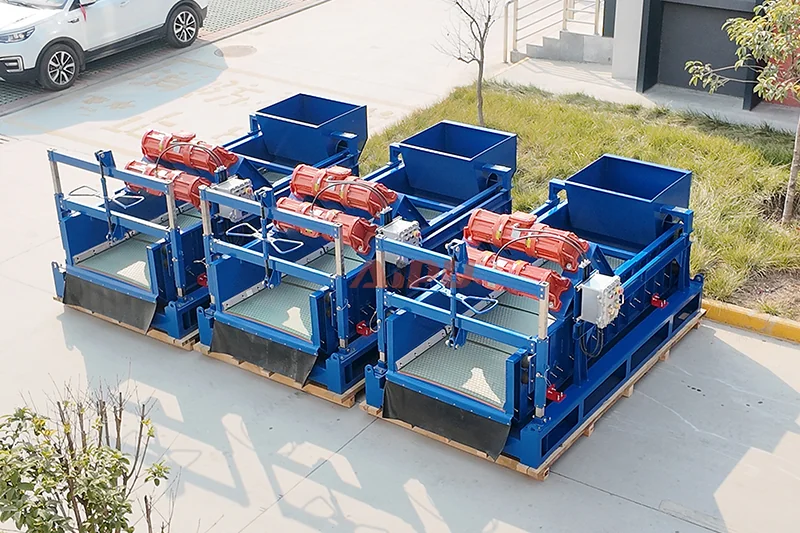
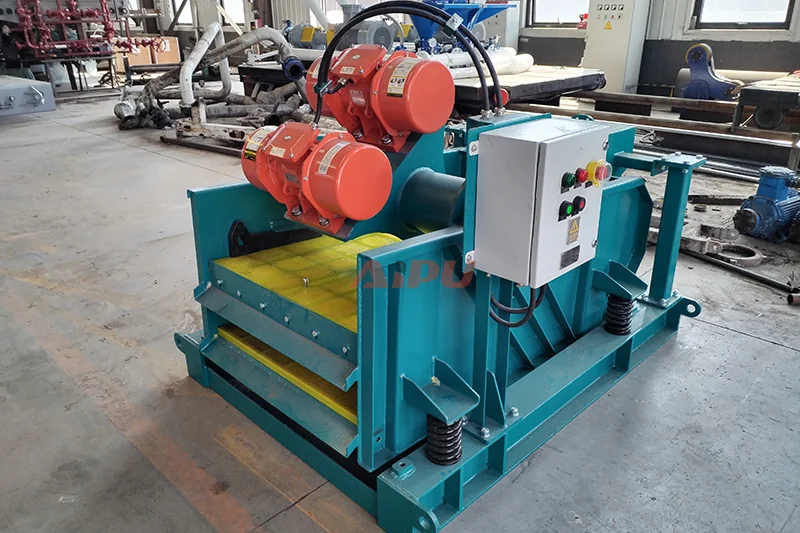
Solids separation efficiency measures how completely a shale shaker removes drilled solids from the returning drilling fluid stream. Higher separation efficiency means cleaner drilling fluid returning to the active system and drier cuttings going to disposal. Aipu shale shakers are engineered to achieve exceptional separation efficiency through optimized vibration characteristics, precision screen technology, and operator-adjustable parameters that allow fine-tuning for specific drilling conditions.

Understanding Separation Efficiency Metrics
Before attempting to improve separation efficiency, it is important to understand how it is measured. The most practical field metric is the comparison of solids content in the drilling fluid before and after the shale shaker. A properly functioning shaker should remove 60 to 80 percent of all drilled solids by volume. Separation efficiency can also be evaluated by examining the cuttings discharge: dry, granular cuttings indicate good fluid separation, while wet, muddy cuttings suggest that significant fluid is being carried off with the solids. Aipu provides guidance to operators on evaluating these indicators and adjusting shaker parameters for optimal efficiency.
Select the Finest Practicable Screen Mesh
The most direct way to improve separation efficiency is to use finer screens that capture smaller particles. However, finer screens also reduce throughput, and at some point the screen becomes so fine that fluid cannot drain at the required rate and is carried off with the cuttings. The art of screen selection is finding the finest screen that still allows adequate throughput for the current flow rate and solids loading. Aipu recommends a systematic approach: start with a screen fine enough to achieve the desired cut point, then progressively coarsen only if throughput becomes limiting. The quick-change screen system on Aipu shakers supports this iterative optimization by making screen changes fast and straightforward.
Optimize Vibration Intensity for the Formation
Vibration intensity, measured as G-force, directly affects how aggressively solids are separated from the drilling fluid. Higher G-force produces better dewatering and faster conveyance but increases screen wear and structural stress. Aipu shakers operate in the optimal range of 6.0G to 7.5G, where separation efficiency is maximized without excessive screen consumption. Within this range, operators can adjust vibration characteristics to match formation properties. Sticky, clay-rich formations benefit from slightly higher G-force to overcome the tendency of cuttings to adhere to screen surfaces. Hard, brittle formations with sharp cuttings may benefit from slightly lower settings that extend screen life without significantly compromising separation.
Maintain Proper Deck Angle
Deck angle affects separation efficiency primarily through its influence on fluid retention time. Lower deck angles keep fluid on the screen longer, allowing more complete drainage and finer separation. However, excessively low angles slow cuttings conveyance and may reduce throughput. Aipu adjustable deck angles from -1 degree to +5 degrees allow operators to find the optimal balance for each hole section. In the upper hole where throughput demands are highest, a moderate positive angle maintains flow capacity. In deeper sections where separation quality is paramount, a reduced or negative angle maximizes efficiency. The tool-free adjustment on Aipu shakers encourages active, condition-specific optimization rather than a set-and-forget approach.
Consider Dual-Motion for Variable Formations
Different formations respond differently to vibration mode, and a single well may drill through formations that ideally require different separation strategies. Aipu Hunter-MGD dual-motion shakers allow operators to select between linear and balanced elliptical vibration trajectories at the flip of a switch. Linear motion provides aggressive, high-conveyance separation ideal for large, heavy cuttings. Elliptical motion offers gentler, more controlled separation that excels with fine, sticky, or fibrous materials. This dual-mode capability allows a single shaker to maintain optimal separation efficiency across the entire range of formations encountered in a typical well, eliminating the compromise of a single-motion shaker.
Prevent Screen Blinding
Screen blinding, where particles become lodged in screen openings and block fluid flow, is a common cause of declining separation efficiency that often goes unrecognized. As screen area is progressively lost to blinding, effective throughput decreases and fluid is carried off with the cuttings. Aipu addresses screen blinding through several design features. The high-frequency vibration of Aipu shakers helps dislodge near-size particles before they become firmly wedged. The balanced motion trajectory prevents the formation of static areas where blinding accumulates. Regular inspection of screen condition and prompt replacement of blinded panels maintains consistent separation efficiency throughout the drilling operation.
Partner with Aipu for superior solids control. Contact us at info@aipusolidcontrol.com to discuss your shale shaker needs and receive a customized solution for your drilling operation.
If you are interested in our solid control equipment and systems, you can contact us through info@aipusolidcontrol.com Contact Us
