
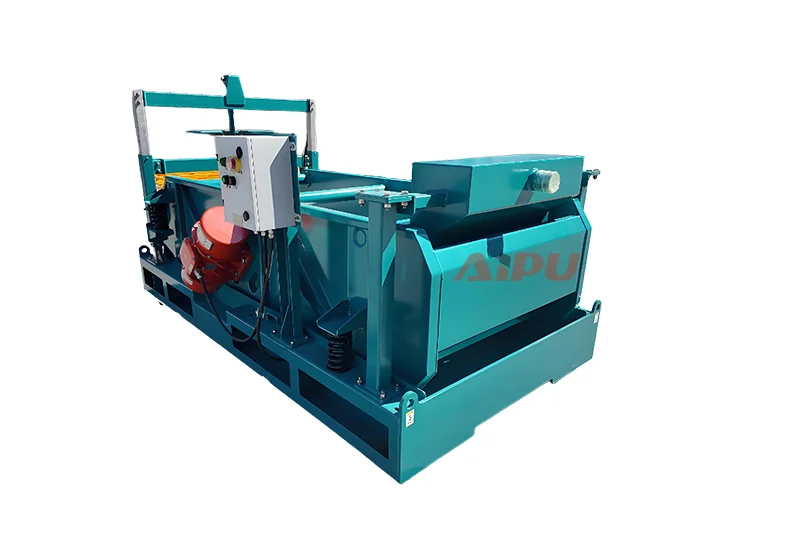
Mud loss at the shale shaker represents drilling fluid that goes to waste with the discharged cuttings. For operations using expensive oil-based or synthetic-based mud, even small mud losses add up to significant costs over the course of a well. Aipu shale shakers are engineered to minimize mud loss through optimized screen technology, vibration control, and operational best practices.


Understanding the Causes of Mud Loss
Mud loss at the shaker occurs when drilling fluid fails to pass through the screen mesh and is instead carried off the end of the deck with the cuttings. This happens for several reasons: screens that are too fine for the flow rate, excessive solids loading that overwhelms the available screen area, high mud viscosity that slows drainage through the mesh, and suboptimal deck angle that reduces fluid retention time. Understanding which factors are contributing to mud loss in a specific operation is the first step toward reducing it.
Optimize Screen Mesh Selection
Using the finest screen that still allows adequate throughput is a fundamental strategy for minimizing mud loss. Screens that are unnecessarily fine for current drilling conditions restrict fluid passage and increase mud carryover. Aipu recommends starting with a coarser screen and progressively moving finer until the optimal balance of separation quality and throughput is achieved. The quick-change screen design on Aipu shakers makes it practical to adjust screen selection as conditions change. For upper hole sections where cuttings are large but fine solids control is less critical, coarser screens dramatically reduce mud loss while still providing adequate separation.
Control Fluid Viscosity
High viscosity is one of the most common and controllable causes of excessive mud loss at the shaker. When drilling fluid is too viscous, it drains slowly through the screen mesh, and the forward motion of the deck carries more fluid off with the cuttings. Maintaining viscosity within the designed specification through proper solids control and chemical treatment directly reduces mud loss. Aipu shakers perform best when the drilling fluid properties are actively managed as part of an integrated solids control strategy.
Adjust Deck Angle for Optimal Retention
The deck angle determines how long drilling fluid remains in contact with the screen surface. Higher angles convey cuttings faster but reduce fluid retention time, potentially increasing mud loss. Lower angles increase retention time and improve fluid drainage but may reduce throughput. Aipu adjustable deck angles allow operators to fine-tune this balance. When mud loss is a concern, reducing the deck angle slightly can significantly improve fluid recovery without a major impact on throughput. The tool-free adjustment on Aipu shakers makes this a quick, practical optimization.
Manage Flow Distribution
Uneven flow distribution across the screen deck is a hidden contributor to mud loss. When mud concentrates on one portion of the deck, that area becomes overloaded and fluid is carried off before it can drain through the screens, while other areas run nearly dry. Ensuring the shaker is level, the weir or flow distributor is clean, and the mud inlet is properly sized all contribute to even flow distribution and maximum utilization of available screen area.
Consider Dual or Tandem Configurations
When a single shaker is operating near its capacity limit, mud loss is almost inevitable. Adding a second shaker or upgrading to a tandem configuration distributes the flow across more screen area, reducing the load on each deck and giving fluid more time to drain. Aipu Hunter-MG4T tandem and Hunter-MG4D double-deck configurations effectively double the screening area within a compact footprint, providing a cost-effective path to reduced mud loss and improved solids control.
Ready to improve your solids control? Contact Aipu at info@aipusolidcontrol.com for expert guidance on selecting and configuring the right shale shaker for your drilling program.
If you are interested in our solid control equipment and systems, you can contact us through info@aipusolidcontrol.com Contact Us
