
In the complex and high-stakes environment of drilling operations, effective drilling fluid management is paramount to safety, efficiency, and cost control. The drilling fluid, or “mud,” serves critical functions: controlling subsurface pressures, cooling and lubricating the drill bit, stabilizing the wellbore, and transporting drilled cuttings to the surface. Once at the surface, this fluid, now laden with solids, must be cleaned and regenerated for reuse. This is where solids control equipment, and specifically the mud cleaner, plays an indispensable role within the drilling fluid processing system.

Fundamentals of Solids Control and the Mud Cleaner’s Niche
The solids control hierarchy typically employs a series of mechanical devices arranged in a sequential removal process. The primary stage involves shale shakers, which use vibrating screens to remove the larger cuttings (typically >74 microns). The fluid then passes through secondary equipment like desanders and desilters (hydrocyclones) to remove finer, abrasive solids in the silt and sand size ranges (15-74 microns). However, hydrocyclones discharge an underflow of solids suspended in a significant volume of liquid, which includes valuable base fluid and chemical additives. Discarding this entire stream is economically and environmentally unsustainable.
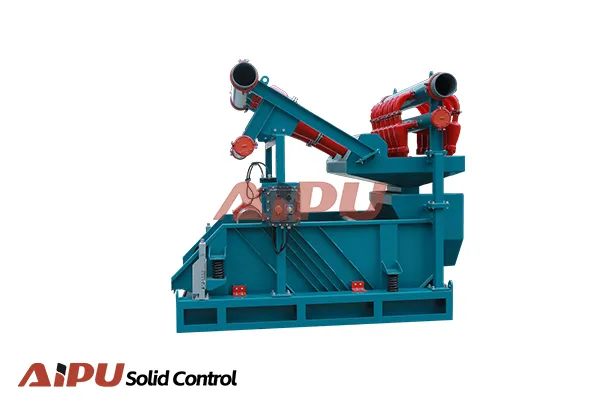
The mud cleaner addresses this precise challenge. It is not a single device but an integrated unit combining a set of fine-mesh hydrocyclones (usually desilters) mounted over a high-speed, fine-screen shale shaker, often a linear motion or balanced elliptical motion shaker. The hydrocyclone underflow is directed onto the vibrating screen. The screen captures the fine solids (typically in the 15-25 micron range, depending on mesh size), while the liquid and particles smaller than the screen mesh pass through and are returned to the active mud system. Essentially, a mud cleaner performs a “liquid-solids separation” on the hydrocyclone underflow, recovering valuable liquid phase that would otherwise be lost.
Key Applications and Operational Scenarios
The deployment of a mud cleaner is strategic and depends on the drilling phase, mud type, and economic considerations.
1. Weighted Mud Systems: This is the most classic and critical application. When drilling fluid is weighted with barite (specific gravity ~4.2) or other weighting materials to control high formation pressures, the primary objective is to remove drilled solids (specific gravity ~2.6) while conserving the expensive, high-density weighting agent. Barite particles are generally in the 15-74 micron range. A mud cleaner, equipped with hydrocyclones cut for 15-20 micron separation and screens of 150-200 mesh (74-100 microns), can effectively discard low-gravity drilled solids while allowing most barite particles, which are finer and in liquid suspension, to pass through the screen back into the system. This process is crucial for maintaining mud weight with minimal dilution and additive consumption.
2. Non-Aqueous Fluid (NAF) / Oil-Based Mud (OBM) Systems: Given the high cost and environmental sensitivity of NAFs, maximizing fluid recovery is a top priority. Mud cleaners are extensively used to minimize whole fluid losses. The recovered base oil is directly returned to the active pits, dramatically reducing new fluid purchases and waste disposal volumes. The efficiency of solids removal in NAFs is often higher due to the fluid’s lower viscosity, enhancing hydrocyclone and screen performance.
3. High-Penetration Rate Sections: During periods of fast drilling, particularly in large-diameter surface holes, the solids loading in the mud increases rapidly. While shale shakers handle the bulk, a mud cleaner working on the desilter underflow provides an essential polishing stage, preventing a progressive buildup of fine solids that increase plastic viscosity, elevate gel strengths, and reduce rates of penetration.
4. Pre-Treatment for Centrifuges: In advanced solids control cascades, the mud cleaner often serves as a feed conditioner for decanting centrifuges. By removing the majority of solids in the 15-50 micron range, the mud cleaner prevents overloading of the centrifuge, allowing it to operate more efficiently for the ultra-fine separation (e.g., barite recovery or sub-10 micron solids removal).
Technical Considerations and Performance Factors
The effectiveness of a mud cleaner is governed by several interlinked parameters:
Hydrocyclone Selection and Operation: The size and number of hydrocyclone cones (e.g., 4″, 5″) determine the cut point (d50) – the particle size at which 50% reports to underflow. Proper feed pressure (typically 75 psi/5.2 bar) is critical for optimal separation efficiency. Under-pressure leads to poor separation; over-pressure causes excessive shear and degradation of solids.
Screen Mesh Selection: The screen mesh must be carefully chosen to balance liquid recovery and solids discharge. Too coarse a mesh
About AIPU Solid Control
For professionals seeking reliable solid control solutions, AIPU Solid Control offers advanced equipment designed for efficiency and durability. Our products are engineered to meet the demanding requirements of modern operations, providing:
- High-efficiency separation technology
- Robust construction for extended service life
- Energy-efficient operation
- Comprehensive technical support
- Customizable solutions for specific operational needs
With a focus on innovation and quality, AIPU Solid Control continues to develop solutions that enhance operational efficiency while maintaining environmental compliance.
If you are interested in our solid control equipment and systems, you can contact us through info@aipusolidcontrol.com Contact Us
