
The design and working principle of shale shaker equipment represent a carefully engineered balance of mechanical dynamics, fluid mechanics, and materials science. Aipu Solids Control, with over 15 years of specialized manufacturing experience, has refined shaker design through extensive field validation and continuous improvement. Understanding how a shale shaker works is essential for operators who want to maximize solids removal efficiency and extend equipment service life.
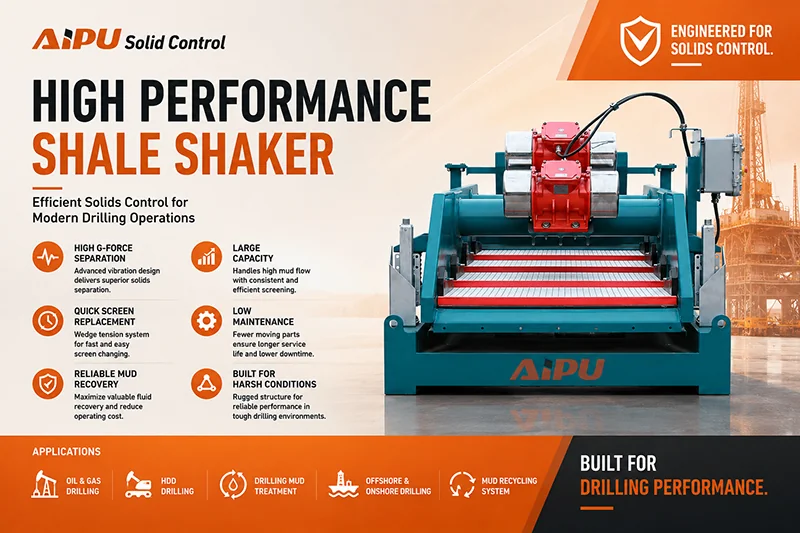


Fundamental Working Principle
At its core, a shale shaker operates on a simple principle: drilling fluid containing drilled cuttings passes over a vibrating screen surface. The vibration, driven by high-quality motors from Ital-Vibras, Martin, or Oli, imparts acceleration forces of 6.0G to 7.5G to the fluid-cuttings mixture. These forces drive fluid through the screen openings while conveying solids toward the discharge end. The drilling mud passes through the screen for recirculation, while separated cuttings are discarded. Aipu Hunter series shakers achieve this with remarkable efficiency, processing flow rates from 50 to 420 cubic meters per hour.
Key Design Elements
Aipu shaker design incorporates several critical elements. The deck structure, manufactured from heavy-gauge structural steel with full penetration welding at joints, provides a rigid platform that transmits vibration energy uniformly. Post-weld heat treatment relieves residual stresses that could lead to fatigue failure. The screen system, featuring quick-change retention mechanisms, allows operators to replace panels in minutes without specialized tools. Adjustable deck angles from minus 1 degree to plus 5 degrees enable optimization of fluid retention time for varying mud properties and flow rates.
Motor Positioning and Vibration Dynamics
The position of vibration motors on the shaker frame determines the motion pattern. Aipu engineers position the paired motors to create the desired acceleration profile. In linear motion shakers, counter-rotating motors are positioned to generate pure linear force along the screen surface. This linear motion provides efficient solids conveyance and effective fluid drainage. In the Hunter-MGD dual-motion series, innovative motor positioning enables switching between linear and elliptical motion without equipment changes.
From Theory to Practice
While the physics of shaker operation are well understood, translating theory into reliable equipment requires manufacturing precision. Aipu 50,000 square meter facility in Xi’an employs CNC machining to ensure flat motor mounting surfaces, precision fabrication of screen support rails, and documented assembly procedures with defined inspection points. Every shaker undergoes factory acceptance testing that verifies vibration characteristics, electrical systems, and mechanical integrity before shipment.
Partner with Aipu for certified quality. Contact us at info@aipusolidcontrol.com to discuss your requirements and discover the Aipu difference in API Q1 certified solids control equipment.
If you are interested in our solid control equipment and systems, you can contact us through info@aipusolidcontrol.com Contact Us
